The short answer
Start from sounds, not rules. Say words slowly, play “what sound does it start with?”, let your child build words from letters they can see and move, and celebrate good tries even when the spelling is wrong. Little and often, and always a game, beats long practice sessions.
What’s normal at this age
Early spelling is supposed to be wobbly. A five-year-old who writes “KAT” for “cat” has done something clever: they heard every sound in the word and picked a letter for each one. The exact spellings come later. What matters first is that a child expects a word to be made of sounds, and expects letters to stand for them.
Children get there at very different speeds, and a few months’ difference at this age is ordinary. If you have real concerns about your child’s hearing, speech or progress, their teacher or doctor is the right person to ask.
Seven playful ideas
Stretch words out loud
Say a word slowly, like elastic: “sssuuunnn”. Ask your child to do it too, then count the sounds on their fingers. Three sounds, three letters.
Play “I spy” with sounds
Swap “something beginning with B” for “something that starts with b-b-b”. Using the letter’s sound rather than its name links the game straight to spelling.
Build words with things you can hold
Magnetic letters on the fridge, letter tiles, or letters written on bottle caps. Moving a letter is easier than writing one, so a child can focus on which letter, not how to draw it.
Go on a letter hunt
Pick a letter for the day and hunt for it on cereal boxes, signs and books. Then hunt for things whose names start with it.
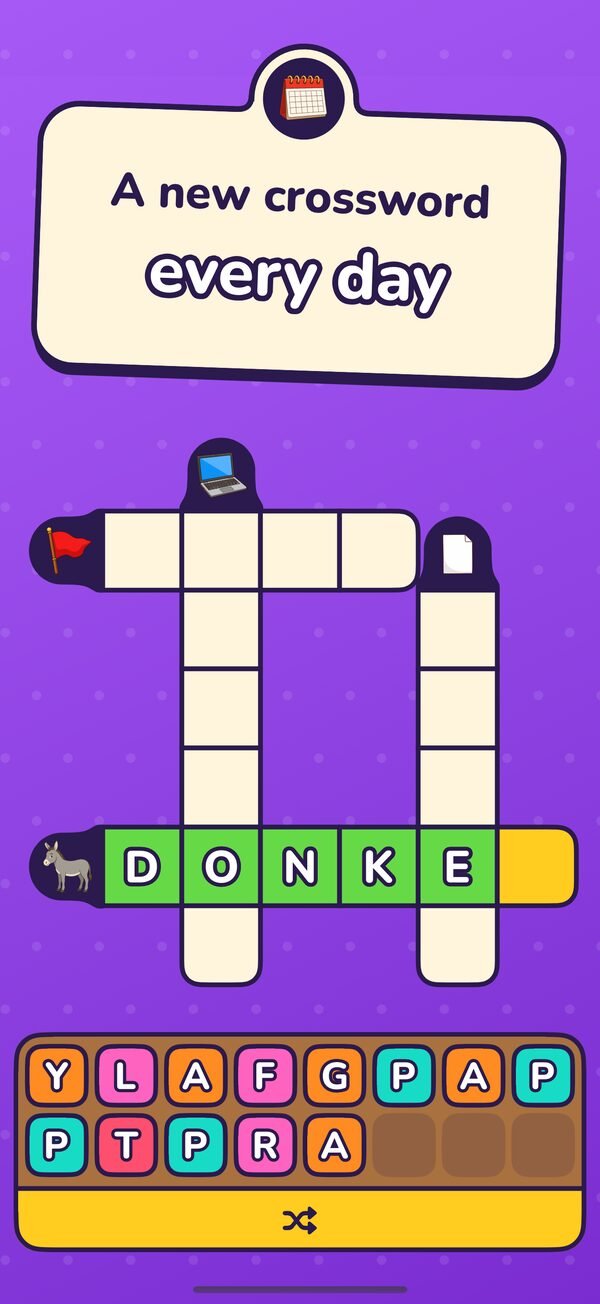
Do a picture crossword
A crossword with picture clues gives a child a word they already know, a set of letters to choose from, and a grid that checks the order. It’s a complete small spelling exercise that feels like a puzzle. More on how they work.
Write for a reason
A shopping list, a label for a drawing, a card for grandma. Children try harder at spelling when someone is going to read the result.
Read together, and point
While you read aloud, now and then run a finger under a short word and sound it out together. Seeing the same words again and again is how spellings settle in.
How to handle mistakes
- Praise the sounds they got right. “You heard the T at the end, brilliant.” Then show the one that’s different.
- Don’t correct everything at once. One fix per word is plenty; a page full of corrections teaches a child that writing is risky.
- Let the game do the checking. Puzzles where the wrong letter simply doesn’t fit take the parent out of the role of judge.
Where a spelling app fits in
An app can’t replace reading together, but it can be a good five minutes in the car or before dinner, as long as it’s built for the purpose: no ads pulling a child away, no reading needed to play, and short rounds that end with a sense of finishing. We wrote a short checklist for choosing one.
Questions parents ask
At what age should a child start spelling words?
Many children start trying to spell simple words between 4 and 5, usually once they know some letter sounds. There’s a wide normal range, and early attempts are expected to be phonetic (“KAT” for “cat”).
Should I teach letter names or letter sounds first?
For spelling, sounds are the more useful starting point, because they’re what a child hears when they say a word. Letter names come along naturally, and many families use both.
How long should spelling practice be?
Short. Five to ten minutes, a few times a week, framed as a game. Stopping while your child still wants more keeps them coming back.
Are spelling games on a tablet any good?
They can be, if they’re designed for young children: no ads, no reading required to play, short rounds, and gentle feedback instead of buzzers. Use them alongside reading together, not instead of it.
More for parents: Crosswords for 4-year-olds · How to choose a learning app for a young child