The short answer
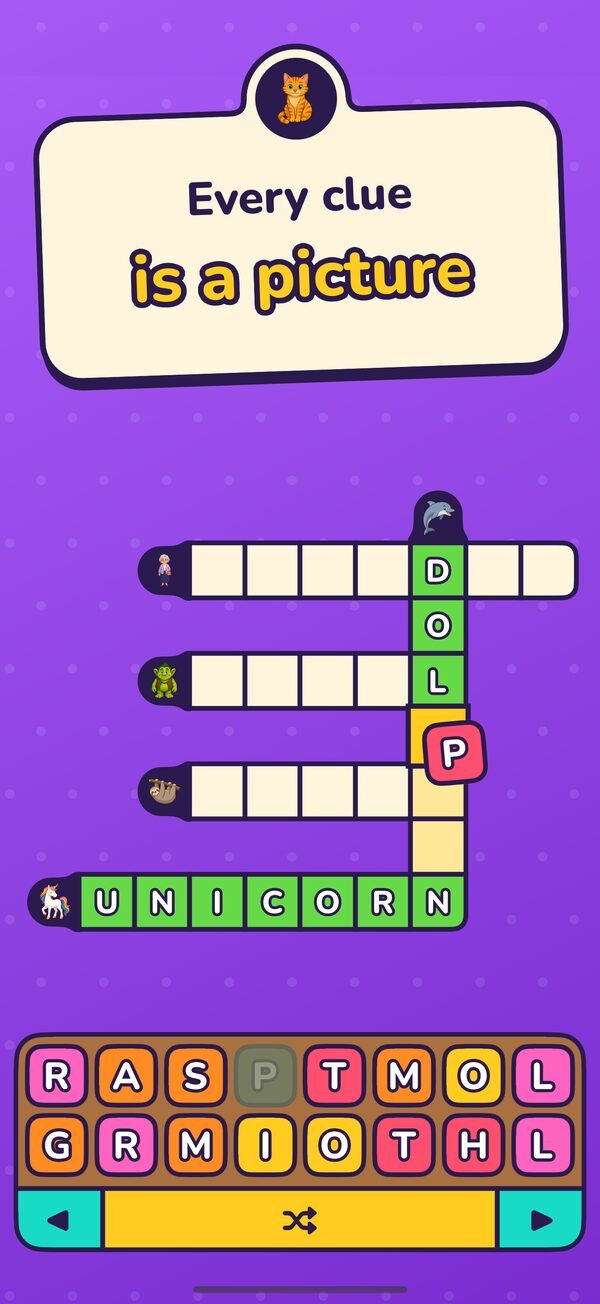
Yes, a 4-year-old can do a crossword when every clue is a picture and the letters are handed to them. The child sees a cat, says “cat”, and finds C, A and T. The grid quietly checks the spelling, and the shared letters where words cross give them a head start on the next word.
Why ordinary crosswords don’t work for small children
A normal crossword asks you to read a clue, think of a word, and then spell it. For a child who is just starting to read, that is three hard jobs stacked on top of each other, and the first one, reading the clue, stops them before the fun begins.
Most children can speak long before they can read. They know “banana”, “rocket” and “umbrella” perfectly well. What they’re learning at four, five and six is how those spoken words map onto letters. A good first crossword starts from what they already know, the spoken word, and leads them to the letters.
How a picture crossword works
In a picture crossword, every clue is a drawing: a cat, a cup, a sun. Next to the grid sits a small tray of letters. The child looks at the picture, says the word, and moves letters into the squares.
- No reading needed to start. The picture is the clue.
- Letters are given, not recalled. Choosing the right letter from a few is much easier than producing it from memory.
- The crossing letters help. Where two words share a square, finishing one word puts the first letter of the next in place, a built-in hint.
- Mistakes are cheap. A wrong letter simply doesn’t fit, so there’s nothing to cross out and nothing to feel bad about.
What a child practises without noticing
Picture crosswords look like a puzzle, but underneath they rehearse the skills early spelling is built from:
Sounds to lettersHearing the “c” at the start of “cat” and finding the C.
Letter orderC, then A, then T, not T, A, C. The grid only accepts one order.
Word lengthThe row of squares shows how long a word is before it’s spelled.
VocabularyNew pictures bring new words, and the spelling arrives with them.
None of it feels like a lesson, which is the point: a child who chooses to do another crossword is practising because they want to.
What makes a good first crossword
- Short, concrete words. Three to five letters, things a child can picture: cat, sun, frog, apple.
- Only a few words per puzzle. Two or three crossing words is plenty at first. Finishing matters more than size.
- Clear pictures. One object, drawn simply, so there’s no doubt whether it’s a “dog” or a “puppy”.
- A gentle way to get unstuck. A shuffle or hint button beats a parent taking over.
- A small celebration at the end. Confetti, a sound, a star. Small children work for the moment of “I did it”.
How to get started together
- Do the first one side by side. Point at a picture and ask “what’s this?” Let your child say the word before any letter moves.
- Stretch the word out loud. “Ccc-aaa-ttt.” Slowing it down makes each sound easier to hear and match.
- Let them place the letters. Resist fixing a wrong letter yourself. Ask “does that sound right?” and let them try another.
- Stop while it’s still fun. One or two crosswords a day is plenty at four. A short, happy session beats a long, tired one.
- Talk about the words afterwards. “You spelled frog! Can you find something else that starts with F?”
Questions parents ask
What age are picture crosswords for?
Roughly ages 4 to 7: from children who know their letters by sight and are starting to link them to sounds, up to early readers who enjoy spelling longer words on their own.
My child doesn’t know all the letters yet. Is it too early?
Not necessarily. Matching a letter they don’t know yet against a short word they do know is a gentle way to meet new letters. Sit with them for the first few and name the letters together.
Are crosswords better than flash cards for spelling?
They do different jobs. Flash cards drill single words; a crossword asks a child to work out the spelling, with the picture and the crossing letters as support. Many children will happily do a crossword long after flash cards have lost their charm.
Is there a picture crossword app without ads?
Yes. Kiddy Crosswords, for iPhone, iPad and Android, uses pictures for every clue, has no ads, and collects no data. The first 15 crosswords and a new daily crossword are free.
More for parents: 7 playful ways to help a child learn to spell · How to choose a learning app for a young child